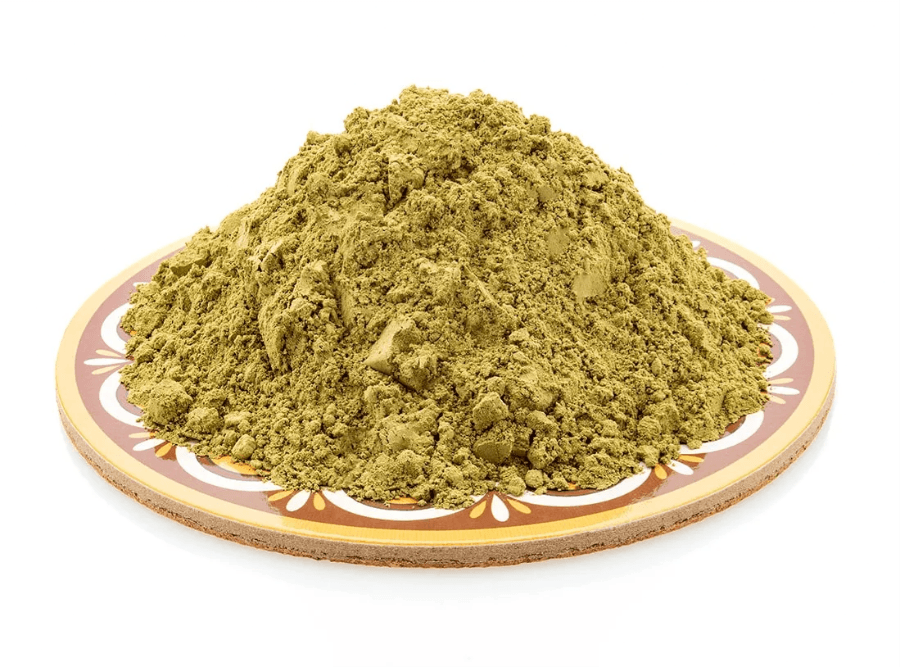
All kratom leaves are green, so why does White Borneo Kratom come out as one of the lightest powders on the market?
The answer lies less in the plant than in centuries-old harvesting and drying practices that shape its final look.
Contrary to popular belief, White Borneo is not a separate species or a genetically modified strain. So, it’s the same Mitragyna speciosa tree as all the other kratom strains. It’s special because of where it’s grown, when the leaves are picked, and how they’re dried.
Even small changes in the timing of the harvest and drying techniques in Indonesia’s Kalimantan rainforests can affect the color, aroma, and overall properties of the powder.
If you want to know more about White Borneo Kratom, including how it compares to other strains such as White Maeng Da or Red Borneo, how it’s typically found, or what to look for while shopping for it, you’ve come to the right place.
White Borneo is a white vein variety of Mitragyna speciosa, the tropical tree native to Southeast Asia that is simply known as kratom. The name “white vein” comes from the color of the stem and central vein of the leaf at harvest and the method of drying that is commonly used afterwards, which is usually shade-dried or dried indoors rather than in direct sun.
Kratom is usually divided into three vein colors:
White Borneo Kratom belongs to the category of white veins, and its name is an allusion to the Indonesian island where it is traditionally cultivated.
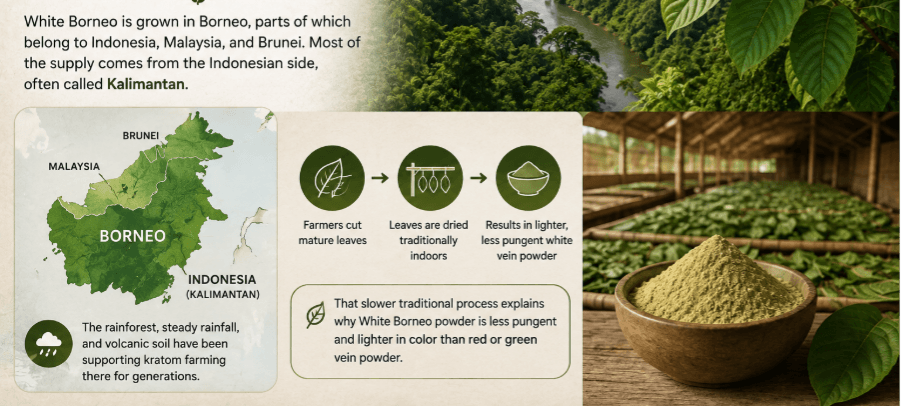
White Borneo is grown in Borneo, parts of which belong to Indonesia, Malaysia, and Brunei. Most of the supply of Kratom White Borneo comes from the Indonesian side, often called Kalimantan. The rainforest, steady rainfall, and volcanic soil have been supporting kratom farming there for generations.
The farmers cut the mature leaves and dry them in the traditional indoor way. That slower process explains why finished white vein powder is less pungent and lighter in color than red or green vein powder.
Long-time users say White Borneo has an earthy, slightly grassy scent with a mild sweetness and a powder color that runs lighter than that of red or green varieties. If you look at a White Borneo Kratom review online, pay attention to the comments about freshness, color consistency, and lab results. These details tell you more about quality than just opinions.
White Borneo Kratom is most often compared to Red Borneo, Green Borneo, and White Maeng Da. Here’s a quick side-by-side comparison of how the four differ:
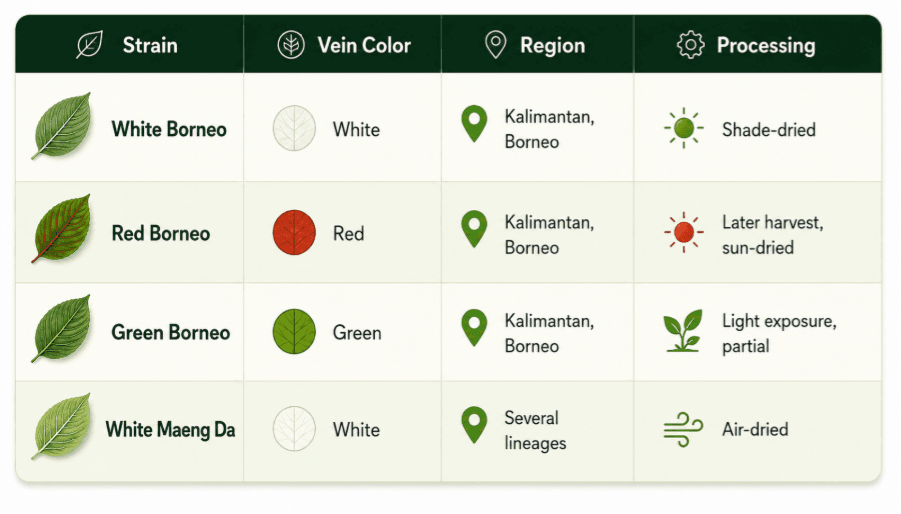
Both are white veins, so the real difference is in plant lineage, not drying method. Maeng Da is a more heavily cultivated hybrid. White Borneo comes from established farms in Kalimantan. The easiest way to tell the fresh batches apart is by smell and the texture of the powder.
People search for “what is White Borneo Kratom used for” to learn about the typical ways it is used in a routine. It is not marketed to treat or prevent any condition. Kratom products are sold in capsule or botanical powder form and are not intended for the prevention, cure, treatment, or diagnosis of disease.
When people search for White Borneo Kratom effects, they’re usually looking for general product information and user reports, not medical advice. Any decision to use kratom should include independent research and, ideally, a discussion with a health care provider, especially given FDA warnings about kratom.
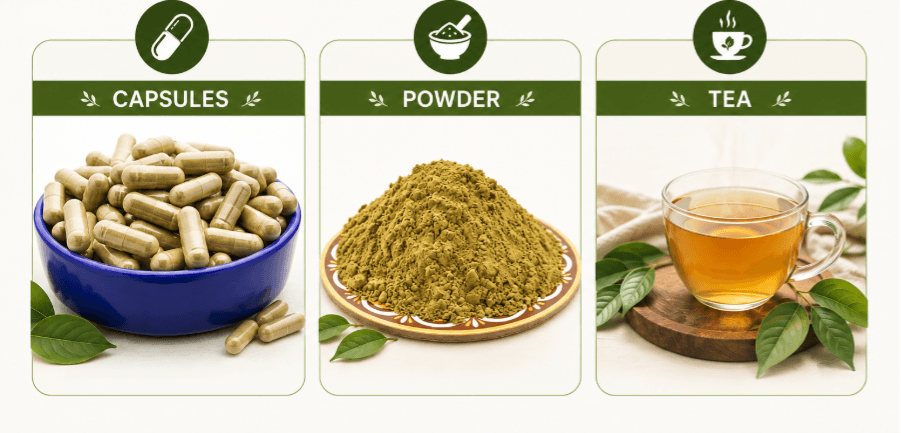
There’s no one right way to use it. Most buyers choose a format for convenience rather than anything else.
Not every vendor does thorough testing, so look for:
To preserve the color, aroma, and alkaloid content of White Borneo, it can be stored in an airtight, opaque container away from heat, light, and moisture.
White Borneo Kratom is harvested earlier than red vein leaves and dried indoors instead of outdoors in the sun, which is what gives it that light color and mild earthy aroma. This is also why White Borneo Kratom is different from White Maeng Da. The difference lies in plant lineage, not processing.
So, order White Borneo Kratom from Bulk Kratom Now with lab results backing every batch and a 30-day guarantee that covers it whether the bag’s been opened or not.

Are you 21 years of age or older?
 Account
 Cart
Cart Questions?
  Login/Register
 View Cart